
Digital accessibility - legal regulations

Legal regulations regarding accessibility in Poland and around the world - an overview
The accessibility of products and services is not only a competitive advantage but also a legal requirement. Global and national institutions have created and continually update accessibility regulations. New regulations, along with related obligations and rights, are constantly emerging. Navigating this maze is no easy task, and translating legal language into practice is even more challenging.
We will summarize selected legal regulations in Poland and around the world that are most important for businesses and institutions. We will focus primarily on issues related to digital accessibility. Let's start from our local, Polish perspective:
Poland
The Accessibility for Persons with Special Needs Act, signed in 2019, sets out obligations only for public entities. It addresses architectural, information and communication and digital accessibility. However, in the latter case, it refers to the Act described below.
The Digital Accessibility of Public Entities' Websites and Mobile Applications Act, signed in 2019, as the name suggests, also does not apply to businesses. However, it does add obligations for non-governmental organizations (NGOs) compared to the previous Act.
It is worth noting that the title of the Act itself specifies both accessible websites and accessible mobile apps.
In practice, fulfilling the requirements of this Act comes down to meeting the requirements of the WCAG version 2.1 guidelines at AA level and publishing an accessibility declaration. Websites must comply with the Act's requirements from September 23, 2020, and mobile applications from June 23, 2021. Non-compliance may result in a fine: up to 10 000 PLN for an inaccessible website or app, up to 5000 PLN for a lack of an accessibility declaration or an inaccessible BIP (Public Information Bulletin).
The complaint submission and review process has been used surprisingly few times, with only 130 complaints submitted by the end of 2024. Approximately half of the reports were approved. It is important to note, however, that the complaint procedure should be simplified and accelerated, and that sanctions should be made more stringent. It is worth remembering, that each of us can, and should, demand accessible digital solutions. Increasingly, it is impossible to benefit from the real world without also utilizing digital solutions. It is also worth recalling that these are publicly funded systems intended to serve everyone.
The Polish Accessibility Act is the common name for the Act of 26 April 2024 on ensuring compliance with accessibility requirements for certain products and services (Journal of Laws of 2024, item 731).
The Act implements the European Accessibility Act (EAA – Directive 2019/882) into Polish law. Information about the EAA can be found later in this article.
The regulation extends accessibility obligations to the private sector. It applies to:
- products – e.g., computers, smartphones, tablets, e-book readers, payment terminals, ATMs, ticket machines, and multimedia equipment;
- services – including telecommunications, audiovisual, retail banking, e-commerce, e-books, as well as websites and applications for passenger transport.
The obligations apply to manufacturers, importers, and distributors (for products) and service providers (for services). Micro-enterprises providing services and certain content, such as maps, are exempt from the requirements.
Every manufacturer must prepare a declaration of conformity, and service providers must prepare a declaration of compliance with accessibility requirements – a document confirming that a given product or service meets the criteria specified in the Act. ⚠️This obligation should not be confused with the accessibility declaration published on the websites of public entities (Act of 2019). Under the Polish Accessibility Act, this information is part of or supplements the CE declaration of conformity for products. For services, the Compliance Information should reflect the actual state of accessibility and be published, for example, on a website.
The State Fund for the Rehabilitation of Disabled Persons (PFRON) is primarily responsible for overseeing the implementation of the Act. In the event of violations, it can impose financial penalties and, in the case of non-compliant products, even order their withdrawal from the market. It's worth noting that these sanctions are significantly more severe for businesses than for the public sector.
- All new products and services introduced to the market after June 28, 2025, must immediately comply with the Act.
- Products available on the market before this date may be sold for a transitional period – until June 28, 2030.
- Services must be available from the moment the regulations come into force.
- Transitional periods do not apply if the product is significantly modified – in which case it must immediately comply with accessibility requirements.
Work is underway on the Act on Equal Opportunities for Persons with Disabilities, which aims to fully implement the provisions of the UN Convention on the Rights of Persons with Disabilities (CRPD) into Polish law.
The new regulations will be horizontal in nature – they will encompass the broadly understood right to equal treatment, accessibility, and support, going beyond the sectoral framework of current laws.
The draft act is currently in the conceptual and consultation stages led by the Ministry of Family, Labor and Social Policy. According to government announcements, its entry into force is planned for 2026–2027, in order to create a systemic foundation for disability policy in Poland.
European Union
The European Accessibility Act (EAA)
Directive 2019/882 (EAA) was adopted in 2019 and establishes common accessibility requirements for selected products and services across the European Union. Its goal is not only to strengthen the rights of people with disabilities but also to harmonise the internal market.
In Poland, the EAA was implemented through the Polish Accessibility Act (PAD), which entered into force on June 28, 2025. Detailed information about the act can be found in the section on national regulations.
How does the EAA complement previous regulations?
The EAA was not created in a vacuum – it complements the previous Directive 2016/2102, which only covered websites and mobile applications of public entities.
The technical fulfilment of accessibility requirements arising from the directives and implementing laws is described in the EN 301549 standard. Directive 2016/2102, which concerns websites and mobile applications of public entities, explicitly refers to the EN 301549 standard as the basis for conformity assessment. Therefore, public institutions must use this standard to comply with legal requirements.
The European Accessibility Act (EAA) extends its requirements to the private sector and other product and service areas, but does not specify a specific standard. It refers to the system of harmonized standards, meaning that compliance with EN 301 549 is not mandatory, but provides businesses with a presumption of legal compliance and provides the safest way to demonstrate compliance.
The EN 301 549 standard covers a wide range of ICT products and services – from computer hardware and terminals to websites and mobile applications. In practice, its application mainly focuses on implementing WCAG requirements. Version V3.2.1 (2021), based on WCAG 2.1 AA, is currently in use. Version V4.1.1, which incorporates WCAG 2.2 and is specifically designed for full application to the EAA and national implementing laws, such as the Polish Accessibility Act, is planned for publication in 2025.
United States
In the United States, accessibility is primarily regulated by the Americans with Disabilities Act (ADA) and Section 508 Rehabilitation Act. Both acts differ in nature from European regulations – in the EU, the main tools are directives implemented by member states and enforced administratively, while in the US, lawsuits and civil disputes play a significant role. Their number numbered in the thousands (over 4,000 lawsuits in 2024) and is growing year by year.
The ADA applies to all public institutions and the private sector offering goods and services. It does not contain detailed technical standards, but courts and regulators generally assume that compliance with WCAG is a presumption of accessibility.
Section 508 applies to federal government contracts. It requires public institutions to purchase only products and services that meet accessibility requirements. Suppliers must prepare a Voluntary Product Accessibility Template (VPAT), in which they declare the degree of compliance of their solution with accessibility criteria – also based on WCAG.
In both systems, the WCAG guidelines are the basis for accessibility assessment. In both the EU and the US, implementing WCAG is a practical way to comply with legal requirements.
Worldwide
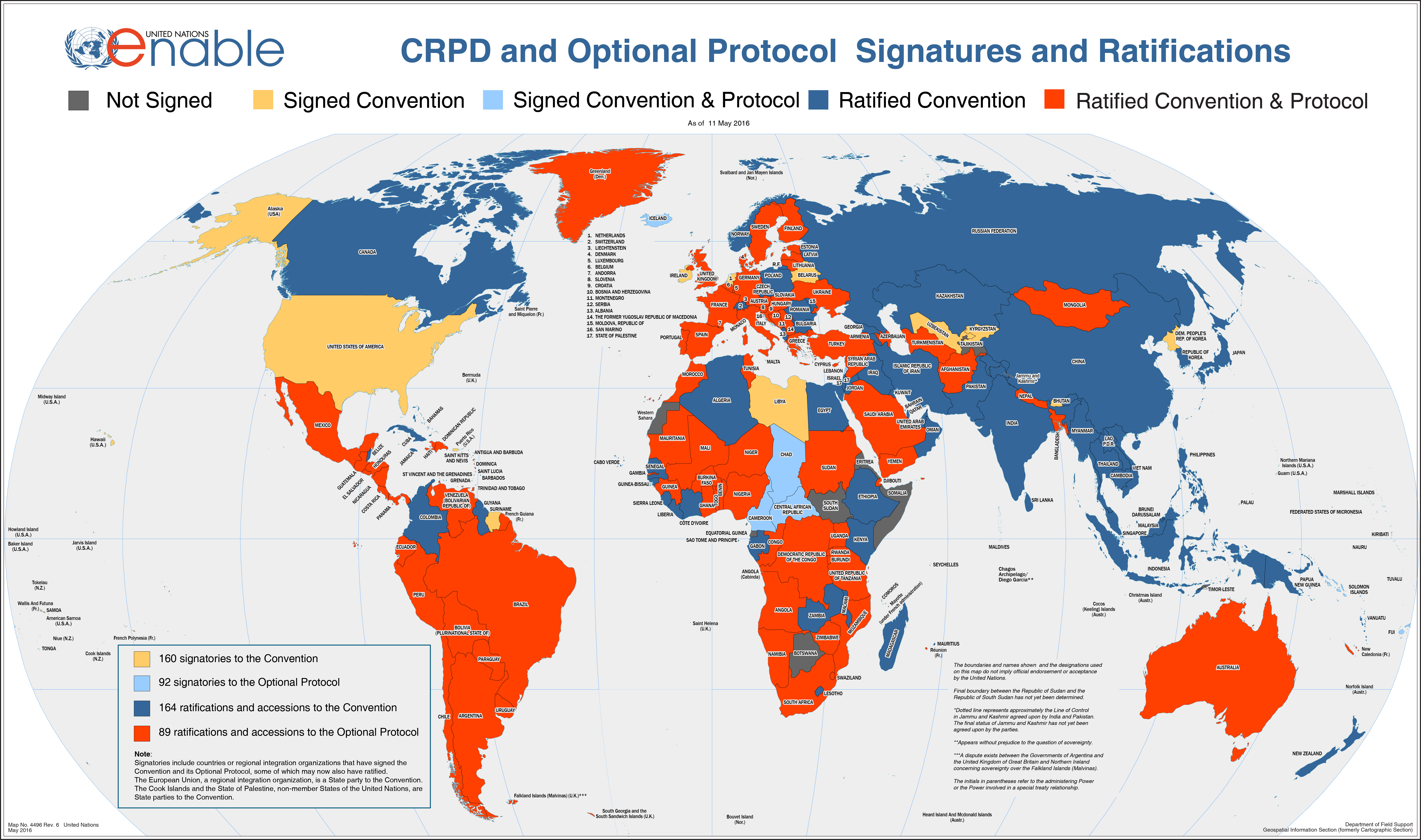
The UN Convention on the Rights of Persons with Disabilities (CRPD) has been ratified by 185 of the 193 UN member states to date; the European Union is also a party. It is this convention that establishes horizontal principles of equal treatment and accessibility, upon which many countries base their own regulations.
Most modern digital accessibility regulations are technically based on the WCAG. Meeting WCAG (usually at Level AA) provides either direct compliance (when the legal act explicitly designates the norm/standard) or a presumption of compliance (when it refers to harmonized or referenced standards). Examples:
- EU: Directive 2016/2102 for the public sector explicitly refers to EN 301 549 (based on WCAG); EAA and national implementations (e.g., PAD in Poland) use the harmonized standards mechanism, where EN 301 549 provides a presumption of conformity.
- Canada: National and provincial requirements (e.g., AODA in Ontario) assess accessibility against WCAG.
- Japan: The JIS X 8341-3 standard for the public sector is WCAG-compliant and recommended by the government.
Many jurisdictions began by regulating the public sector and then extended obligations to the private sector in key areas (transportation, banking, e-commerce, telecommunications). This is clearly evident in the EU (from Directive 2016/2102 to the EAA/PAD) and in solutions such as the AODA in Canada.
Regardless of how individual countries enforce regulations, applying WCAG is the most reliable way to comply with legal requirements in most countries—either because the regulations explicitly refer to them or because they recognize them as the basis for a presumption of conformity.

Dawid Górny
Chief Accessibility Officer and co-founder at Accens
Lawyer, consultant in audiodescription and accessibility of products and services. Digital accessibility tester, has been using assistive technologies on a daily basis for 30 years. President of the Foundation for the Blind and Visually Impaired 'VEGA', art and culture accessibility advocate. Certified IAAP Certified Profesional in Accessibility Core Competencies (CPACC).
Complicated? Maybe a little, but it all really boils down to the same fundamentals. If you are interested in finding out how your product complies with the above-mentioned regulations, consider an accessibility testing or a WCAG audit.
Those who would like to test their solutions themselves may be interested in digital accessibility training.